

There’s a hidden system in your home dedicated to circulating your air. Don’t know anything about your ductwork? You’re not alone. When homes have air duct issues like cold or hot spots, homeowners tend to avoid those rooms. And when they do, without realising it, they’ve lessened the liveable amount of square footage in their homes.
From uneven room temperatures, to excess dust, and high electricity bills, air duct issues can cause daily despair to homeowners and renters alike. What follows is a homeowner’s guide to air ducts; we’ll explain everything you need to know so you can rid yourself of those burdensome cold or hot spots and reclaim your rooms.
Get the Comfort You Deserve
What's An Air Duct?
Check this out – Air ducts, or HVAC ductwork, or AC ducts, are conduits that supply warm or cool air to heat, ventilate, and cool each room. Air ducts are connected to the HVAC unit which filters then heats or cools your home’s air before sending it off. Air ducts are a vital part of your HVAC system, providing thermal well-being and good indoor air quality to your family.
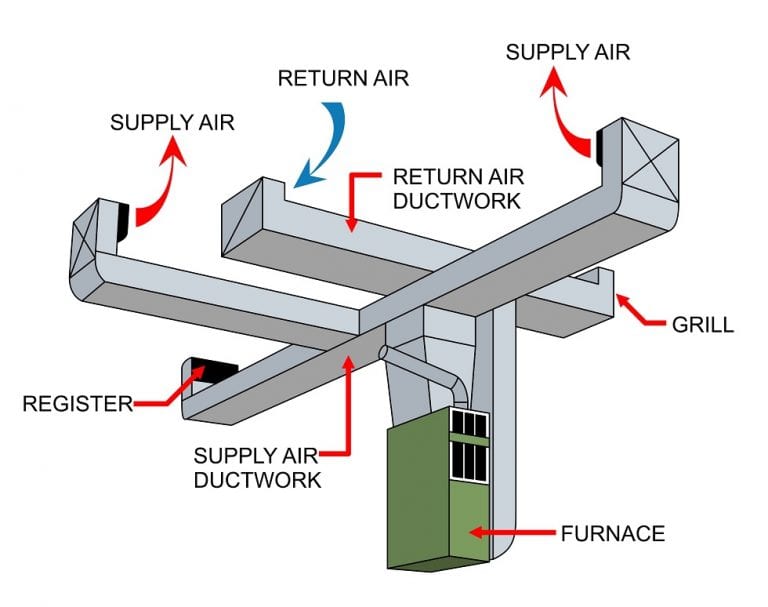
Next, let’s see what air ducts are made of.
Types Of Air Ducts
Sheet Metal Duct
Galvanized steel or aluminum air ducts can be round, oval, or rectangular like the one Bruce Willis crawls through in Die Hard. Sheet metal HVAC ductwork is the most durable and least likely to harbor mold. Metal air ducts are practically rustproof, especially galvanized steel with its zinc coating.
Flex Duct
Simply put, flex ducts are made from a steel wire spiral, wrapped with a polymer (a bendable plastic), and surrounded by insulation. This kind of ductwork is inexpensive, lightweight, and easy to install. Flex ducts work wonders in tricky spaces where more rigid ductwork will not do.
Fiberboard Duct
This type of duct has two layers: compressed resin-bonded inorganic fiberglass is encased in foil to prevent air and water vapor from penetrating. Typically, this air duct is the least expensive, prevents noise, and is already well insulated. The downside? The rough fiberglass surface inhibits airflow.
Beware – old fiberboard ducts aren’t treated to prevent mold or mildew and should be replaced immediately. If you suspect you have old fiberboard ductwork, do not attempt to clean it. The surface damage will release fiberglass into the air and throughout your home.
Now that we’ve covered air ducts materials, let’s look at the various air duct components.
How Air Flows In A Forced Air Duct System
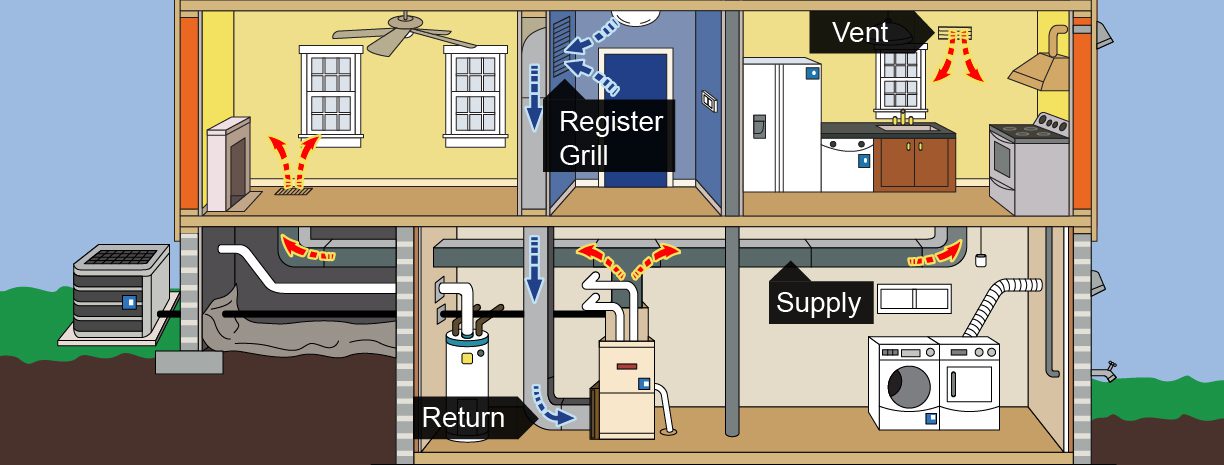
In HVAC systems, your air goes through a cycle. A negative pressure in the ducts sucks the air in, passing it through a filter. The cleaned air is heated or cooled and sent back to the areas of your house where it stays until it’s cycled again.
Return Ducts
Contrary to popular belief, HVAC systems get their air from inside the building. Return ducts extract air from the living spaces back to the HVAC unit, feeding either your furnace or air handler. Return vents are usually larger than supply vents and are called grills. A filter is often installed either deep inside a return duct or right at the return grill to protect your HVAC unit from impurities.
Supply Ducts
Supply ducts blow warm or cool air to an area inside a home. Supply vents often have dampers to control the flow, called registers. Supply registers will often be installed near windows or doors to better counteract the loss of heat or cold, and two supply registers may be installed in larger rooms to evenly distribute the HVAC air.
Great, we’ve covered airflow basics.
But what happens when you air ducts aren’t up to standards?
Signs Your Ductwork Is Bad
Hot & Cold Spots
This is the ultimate tell-tale sign you have air ducts issues. You’ve likely felt it before. You walk into a room and it’s too hot, or you walk down the stairs and it’s noticeably colder, more than 3 degrees. If this is the case, use a thermometer to confirm. Once you’re certain of the discrepancy you can call an HVAC professional. They’ll pinpoint the cause, come up with a plan, and put the plan to action. Learn more about how to fix hot & cold spots here.

Little Or No Air Flow From Supply Vent
An easy way to check this is to place a piece of paper in front of the supply opening. If the paper doesn’t bend like it’s doing the limbo, something is preventing airflow. If you’re lucky, the damper on your register is closed and simply needs reopening. If that doesn’t work, you may need to call an HVAC expert.
High Utility Bills
Up to 30 percent of the air in your ducts may be escaping (High Bills). When conditioned air leaks out or heated air is lost through under-insulated air ducts, the charges show up on your utility bill. The scary part is you probably won’t notice. You may eventually discover through a utility usage report that you are using way more electricity than other similar homes in your neighborhood.
Loud Noise
Wait a minute, doesn’t the HVAC unit make noise when it’s running? It sure does, but the sound shouldn’t annoy the living heck out of you.