
Owning a home can be a nuisance. On top of the monthly bills, renovations, and maintenance, you need to deal with the dreaded repairs. As a homeowner, you’re eventually going to encounter an air conditioner leaking water. What starts as a mild inconvenience can destroy ceilings, walls, and floors, not to mention the AC’s performance, and efficiency. What’s worse – mold can develop in moisture ridden areas and pollute the air you breath. And before you know it, your AC won't turn on or not cooling. We’re here to make sure that never happens. Our team at SuperTech HVAC has repaired hundreds of leaky ACs, so we know a thing or two.
Is your air conditioner leaking water? Read on
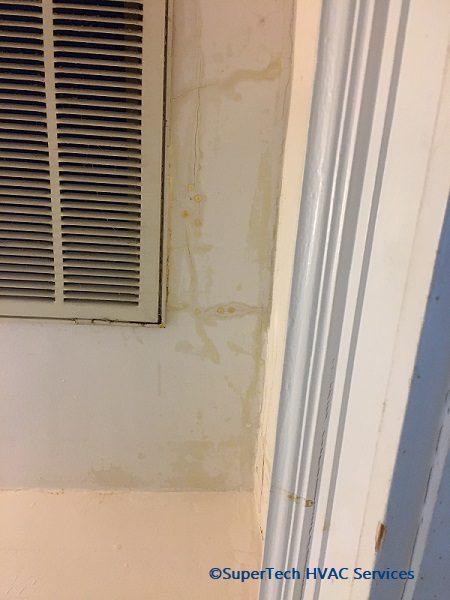
Ceiling drywall damage due to AC leaking
How Does My AC Work And Why Does It Form Water?
First things first, your AC doesn’t cool your air. It removes the heat and transfers it outside.
This is done via three stations:
- A filtered return vent sucks the warm humid indoor air from the living areas and blows it over the evaporator coil. The heat is absorbed by the cold refrigerant in the coil which turns it into hot gas. The air, which is now cool, is blown back into the living areas through the supply vents by a fan.
- The hot gas in the coil makes its way to the compressor outside, which compresses it into an even hotter vapor.
- When the hot gas finally reaches the condenser, heat is discharged outdoors. The refrigerant, now a cold liquid again, returns to the first station to absorb more warm indoor air.
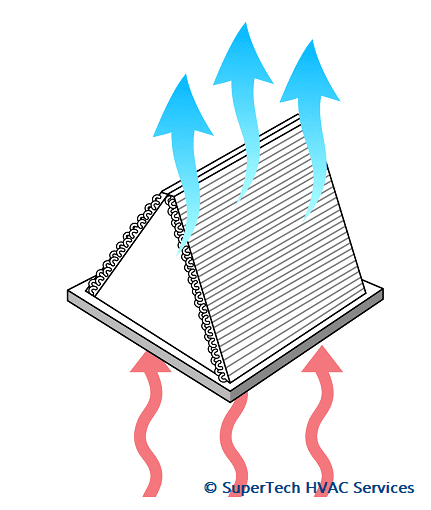
How AC cools air
During this process, while warm humid indoor air is repeatedly being blown over the coil and the heat is being extracted, the moisture from the humid air collects on the evaporator coil and then drips into the primary drain pan, then slides down a drain line that goes outside.
Check this out – water drips into the drain pan and down the drain line every air conditioning cycle.
You’re probably wondering, if water accumulation and dripping is normal, how can you tell something is wrong with your AC?
Let’s find out.
How Do I Know If My Air Conditioner Is Leaking Water?
If your AC is leaking water something is halting the normal cooling cycle. There are signs you can watch for.
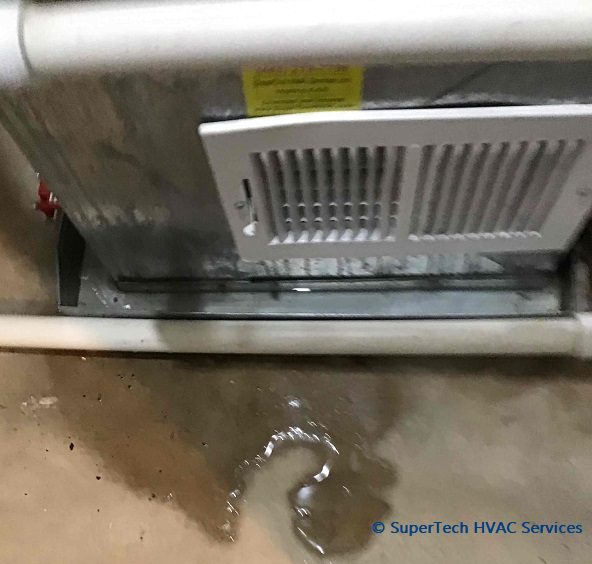
Notice a puddle around your basement or closet unit, or smell mold?
The water from a leaking attic unit can flood your ceiling and drip down your walls while you’re out. The horror.
Thankfully, you can prevent water damage from an air conditioner leaking water inside your home by asking an HVAC pro to install addtional safety switches. These safety features are not required by code, so they typically aren’t included in most HVAC installations.
They are, however, part of SuperTech’s new AC unit installation.
Here are two common switch examples:
- A pan switch is connected to your AC and shuts the unit off if tripped. This happens when too much water accumulates in the drain pan.
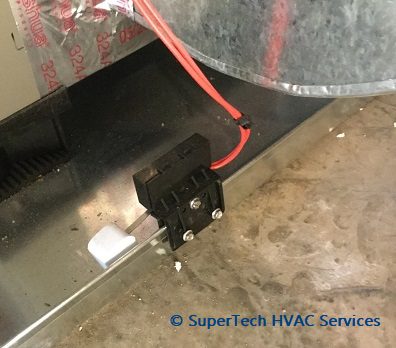
Pan Switch
But, if the pan switch is improperly installed, or the drain pan sits at an angle, the switch may not be tripped before the AC water overflows and causes damage to your home.
- An E-Z trap installed directly on the drain line has a similar purpose. The clear tubing allows you to see a clog when it forms. If you don’t check and clear it in time, and the water accumulates in the line, a float switch trips and sends a signal to your thermostat to shut the system off. Crisis averted.

ez trap safety switch
Now, I know what you’re thinking – what causes an AC to leak water?
Let’s look at the four most common reasons:
Air Conditioner Leaking Water Due To The Damaged Drain Pan
Remember, the drain pan in your AC system catches the condensation on the coils as it drips off. Your drain pan setup will depend on the type of AC unit you have as well as its location.
But the purpose remains the same.
All systems have a primary drain pan. It is directly underneath the evaporator coil. Horizontal systems require a secondary drain pan, placed beneath the entire unit (not just the coil) to catch any runaway liquid from an AC dripping water, especially if the unit is in your attic.
